
In this suit, Caleb, a man of color, was suing to gain his freedom from slavery. The story behind this suit is told on another page.
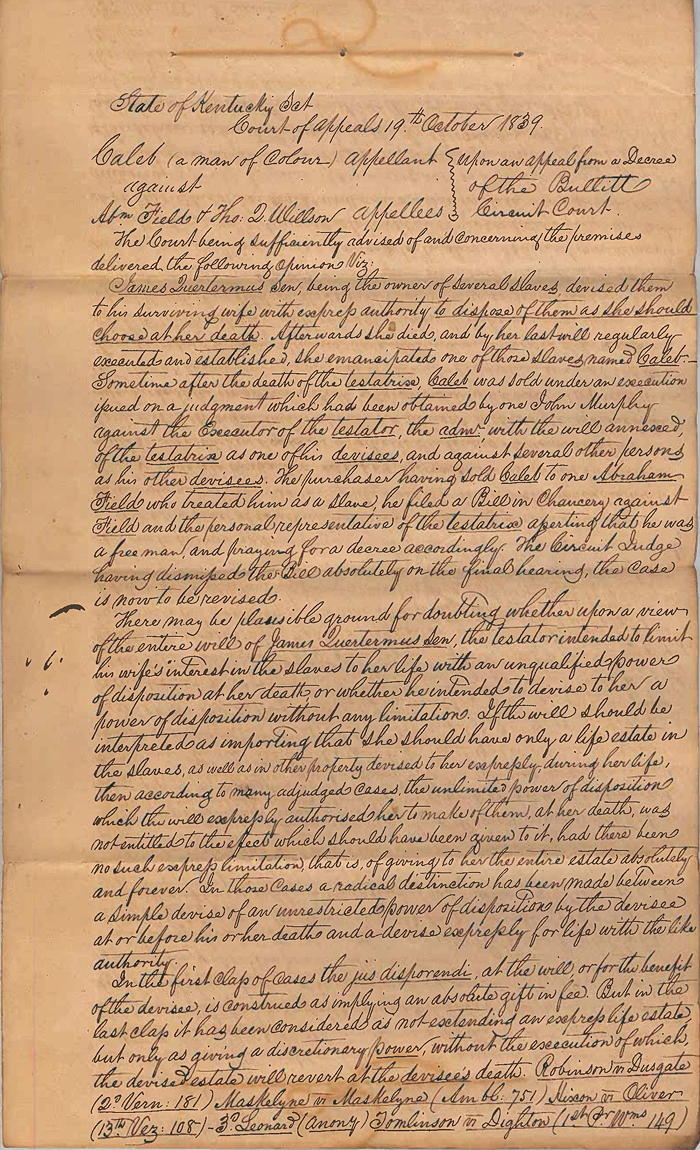
State of Kentucky Sct
Court of Appeals, 19th October 1839
Caleb (a man of color), appellant against Abraham Field & Thomas Q. Willson, appellees; upon an appeal from a decree of the Bullitt Circuit Court.
The Court being sufficiently advised of and concerning the premises, delivered the following opinion, Viz.
James Quertermus, senior, being the owner of several slaves, devised them to his surviving wife, with express authority to dispose of them as she should choose at her death. Afterwards, she died, and, by her last will, regularly executed and established, she emancipated one of those slaves named Caleb. Sometime after the death of the testatrix, Caleb was sold under an execution issued on a judgment which had been obtained by one John Murphy against the executor of the testator, the administrator with the will annexed, of the testatrix, as one of his devisees, and against several other persons, as his other devisees. The purchaser having sold Caleb to one Abraham Field, who treated him as a slave, he filed a bill in chancery against Field, and the personal representative of the testatrix, asserting that he was a free man, and praying for a decree accordingly. The Circuit Judge having dismissed the bill absolutely, on the final hearing, the case is now to be revised.
There may be plausible ground for doubting whether, upon a view of the entire will of James Quertermus Sr., the testator intended to limit his wife's interest in the slaves to her life, with an unqualified power of disposition at her death, or whether he intended to devise to her a power of disposition without any limitation. If the will should be interpreted as importing that she should have only a life estate in the slaves, as well as in other property devised to her expressly during her life, then, according to many adjudged cases, the unlimited power of disposition which the will expressly authorized her to make of them at her death, was not entitled to the effect which should have been given to it had there been no such express limitation, that is, of giving to her the entire estate absolutely and forever. In those cases, a radical distinction has been made between a simple devise of an unrestricted power of disposition by the devisee at or before his or her death, and a devise expressly for life, with the like authority.
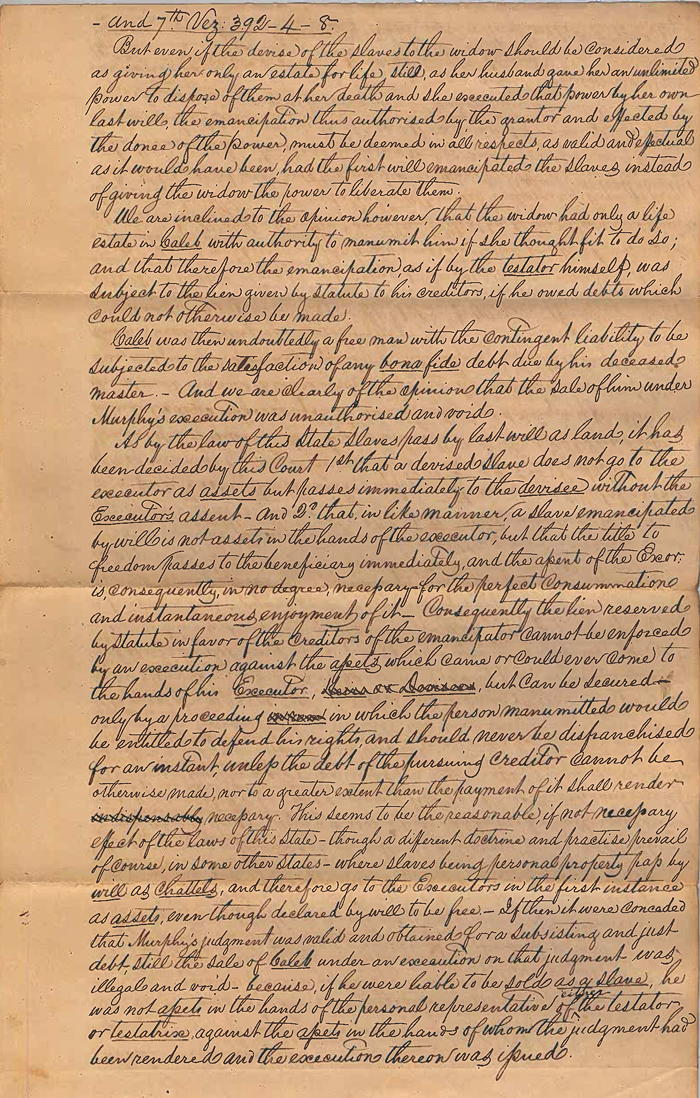
In the first class of cases, the jus disponendi, at the will or for the benefit of the devisee, is construed as implying an absolute gift in fee. But in the last class, it has been considered as not extending an express life estate, but only as giving a discretionary power, without the execution of which the devised estate will revert at the devisee's death. Robinson vs Dusgate, (2 Vern. 181); Maskelyne vs Maskelyne, (Ambl. 751); Hixon vs Oliver, (13 Ves. 108); 3 Leonard, Anon.; Tomlinson vs Dighton, (1 Pr. Wms. 149); and 7 Ves. 392, 4, 8.
But even if the devise of the slaves to the widow should be considered as giving her only an estate for life, still, as her husband gave her an unlimited power to dispose of them at her death, and she executed that power by her own last will, the emancipation, thus authorized by the grantor, and effected by the donee of the power, must be deemed, in all respects, as valid and effectual as it would have been had the first will emancipated the slaves, instead of giving the widow the power to liberate them.
We are inclined to the opinion, however, that the widow had only a life estate in Caleb, with authority to manumit him if she thought fit to do so; and that therefore the emancipation, as if by the testator himself, was subject to the lien given by statute to his creditors, if he owed debts which could not otherwise be made.
Caleb was then undoubtedly a free man with the contingent liability to be subjected to the satisfaction of any bona fide debt due by his deceased master. And we are clearly of the opinion that the sale of him, under Murphy's execution was unauthorized and void.
As, by the law of this State, slaves pass by last will as land, it has been decided by this Court 1st. that a devised slave does not go to the executor as assets, but passes immediately to the devisee without the executor's assent. And 2nd. that, in like manner, a slave emancipated by will, is not assets in the hands of the executor, but that the title to freedom passes to the beneficiary immediately, and the assent of the executor is, consequently, in no degree necessary for the perfect consummation and instantaneous enjoyment of it. Consequently, the lien reserved by statute in favor of the creditors of the emancipator cannot be enforced by an execution against the assets which came, or could ever come, to the hands of the executor; but can be secured only by a proceeding in which the person manumitted would be entitled to defend his rights, and should never be disfranchised for an instant, unless the debt of the pursuing creditor cannot be otherwise made, nor to a greater extent than the payment of it should render necessary. This seems to be the reasonable, if not necessary, effect of the laws of this State - though a different doctrine and praçtice prevail of course in some other states – where slaves being personal property, pass by will, as chattels, and, therefore, go to the executors in the first instance as assets even though declared by will to be free. If then it were conceded that Murphy's judgment was valid, and obtained for a subsisting and just debt, still the sale of Caleb under an execution on that judgment, was illegal and void because, if he were liable to be sold as a slave, he was not assets in the hands of the personal representative of either the testator or testatrix against the assets in the hands of whom the judgment had been rendered, and the execution thereon was issued.
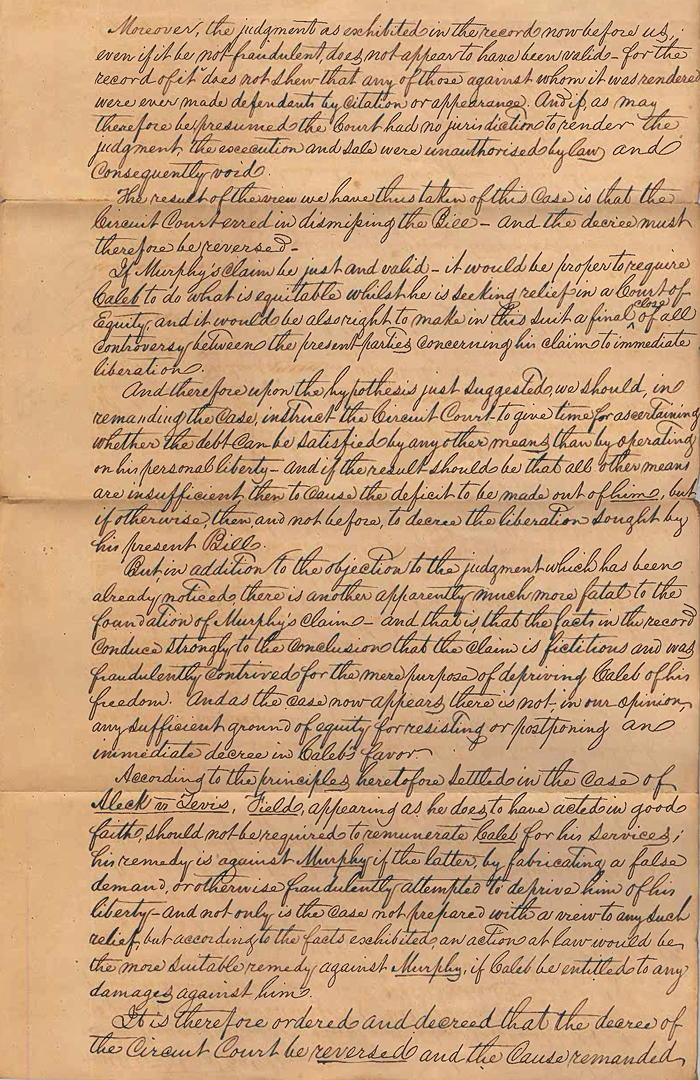
Moreover, the judgment, as exhibited in the record now before us, even if it be not fraudulent, does not appear to have been valid – for the record of it does not show that any of those against whom it was rendered were ever made defendants by citation or appearance. And if, as may therefore be presumed, the Court had no jurisdiction to render the judgment, the execution and sale were unauthorized by law, and consequently void.
The result of the view we have thus taken of this case, is, that the Circuit Court erred in dismissing the bill – and the decree must therefore be reversed.
If Murphy's claim be just and valid, it would be proper to require Caleb to do what is equitable, whilst he is seeking relief in a court of equity; and it would be also right to make in this suit, a final close of all controversy between the present parties, concerning his claim to immediate liberation.
And therefore, upon the hypothesis just suggested, we should, in remanding the case, instruct the Circuit Court to give time for ascertaining whether the debt can be satisfied by any other means than by operating on his personal liberty. And if the result should be that all other means are insufficient, then to cause the deficit to be made out of him; but if otherwise, then, and not before, to decree the liberation sought by his present bill.
But, in addition to the objection to the judgment which has been already noticed there is another apparently much more fatal to the foundation of Murphy's claim – and that is, that the facts in the record conduce strongly to the conclusion that the claim is fictitious and was fraudulently contrived for the mere purpose of depriving Caleb of his freedom. And, as the case now appears, there is not, in our opinion, any sufficient ground of equity for resisting or postponing an immediate decree in Caleb's favor.
According to the principles heretofore settled in the case of Aleck vs Tevis, Field, appearing, as he does, to have acted in good faith, should not be required to remunerate Caleb for his services; his remedy is against Murphy, if the latter, by fabricating a false demand or otherwise fraudulently attempted to deprive him of his liberty; and not only is the case not prepared with a view to any such relief, but, according to the facts exhibited, an action at law would be the more suitable remedy against Murphy, if Caleb be entitled to any damages against him.
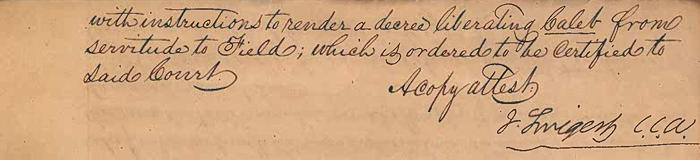
It is therefore ordered and decreed that the decree of the Circuit Court be reversed, and the cause remanded, with instructions to render a decree liberating Caleb from servitude to Field; which is ordered to be certified to said court.
A copy attest: J. Swigert, C.C.A.
This web page is copyright 2026 by the Bullitt County History Museum, Shepherdsville KY. All rights are reserved.
If you, the reader, have an interest in any particular part of our county history, and wish to contribute to this effort, use the form on our Contact Us page to send us your comments about this, or any Bullitt County History page. We welcome your comments and suggestions. If you feel that we have misspoken at any point, please feel free to point this out to us.
The Bullitt County History Museum, a service of the Bullitt County Genealogical Society, is located in the county courthouse at 300 South Buckman Street (Highway 61) in Shepherdsville, Kentucky. The museum, along with its research room, is open 10 a.m. to 4 p.m. Monday through Friday. Saturday appointments are available by calling 502-921-0161 during our regular weekday hours. Admission is free. The museum, as part of the Bullitt County Genealogical Society, is a 501(c)3 tax exempt organization and is classified as a 509(a)2 public charity. Contributions and bequests are deductible under section 2055, 2106, or 2522 of the Internal Revenue Code. Page last modified: 12 Apr 2026 . Page URL: bullittcountyhistory.org/bchistory/caleb-willson-courtappeals.html
