
The following article by Charles Hartley originally appeared in The Pioneer News in July 2026.
It is archived here for your reading enjoyment.
Leading up to the Civil War, counties in Kentucky mostly stored their legal records at their courthouses, or at separate clerk's offices as was the case in Bullitt County. Such records included deeds, wills, marriage records, court order books, and several other important records.
Over time some counties experienced record lost due to fires, and these losses were compounded during the war by deliberate burnings mostly by Confederate forces and Southern guerrilla fighters who targeted courthouses to disrupt local governance and destroy legal documents. In all 22 courthouses were set ablaze in the state.
After the war ended, state and local officials recognized the need to better protect legal records, and in February 1867, the Legislature passed an Act requiring all County Courts to have one or more fireproof vaults for the safe-keeping of their public records.
The law specified that such fireproof vaults or buildings were to be paid for out of the county levy, a set tax levied on all adult males in the county.
Like some other counties, Bullitt County was slow in responding to this law, and in February 1870 it was given two additional years to meet its requirements.
The County Clerk's office was then located at the corner where the old Bullitt County Bank building sits today.
Here the county had built a brick office for the County Clerk in 1811, which the Circuit Court Clerk usually shared. Despite numerous repairs, by the Civil War it was really showing its age. Its record books were generally stored on open shelves or in wooden cabinets.
The Bullitt County Court addressed this issue at its November 1870 Court of Claims by appointing W. J. McConathy, Wilhite Carpenter and R. M. Harshfield commissioners to report to the court on the probable costs of a new courthouse to include a clerk's office with a fireproof safe, or separate clerks' offices with fireproof vaults.
Then in February 1871, at the county's request, the Legislature passed a further Act making it lawful for the county to levy a property tax not exceeding forty cents of each $100 worth of property to be used exclusively for the building of a courthouse and county and circuit court clerks' offices, and for repairing and remodeling the county jail or for one or more of said purposes, as may seem necessary.
However, the Act required that a majority of the justices concur before the tax could be levied.
In August 1870, Wesley Phelps had been elected County Judge, replacing Wilhite Carpenter. At that time there were eight Justices of the Peace, called magistrates today, two from each of the four county districts. The Shepherdsville district, numbered as one, likely included all of the county north of Salt River and west of Floyd's Fork. William McNutt and James Caswell were its representatives. George F. Collings and William Fox represented District Two (Mt. Washington) which likely included the northeastern part of the county. The part south of Salt River was divided into District 3 (Pine Tavern) represented by Walter Carlisle and James M. Carpenter, and District 4 (Leaches) represented by James V. Crenshaw and C. C. Weller.
In March 1871, the commissioners reported that a new courthouse was not needed, but the clerks' offices were in dilapidated condition, and a new office was needed to be built to accommodate a fireproof vault.
Carpenter and Harshfield were joined by Felix Harris as appointed commissioners to determine where to build such an office and on what site; and they returned in April with their report. Present at that meeting were County Judge Phelps along with Justices Caswell, Weller, Crenshaw, McNutt and Carpenter which formed a quorum.
On a motion to build a new clerk's office, Justices Crenshaw, Weller and Carpenter opposed the motion while Justices McNutt and Caswell and Judge Phelps were in favor, resulting in a tie vote. They then voted on trying to repair the old clerk's office which resulted in another tie vote with the former yeas voting nay, and vice versa.
They finally agreed to let two men including Andon Gild, a respected carpenter, to take one more look at the old office to see what might be done.
It was June 1871 before they again took up this issue. By this time, William Shawler of the Pine Tavern District had joined the court as a Justice of the Peace.
Gild and W. A. Evans made their report that "the present County and Circuit Court clerk's office could not be repaired on the old walls and foundation so as to make them fireproof with any degree of certainty; that the old foundation and walls would not safely support a fireproof ceiling and roof; that a tin roof might be put on the present walls and house and be repaired for about $800; but it would not be fireproof and that there was no room for a fireproof vault in the present building."
They then took another vote on building a new office, and with Phelps and Caswell voting yes, and Weller, Crenshaw, Shawler and Carpenter saying no, the motion was again defeated. It seemed that the sticking point was how they would go about paying for it, with most of them opposing the idea of another tax.
But time was running out. With the Legislature unwilling to extend their time beyond November 1872 for completion, the Court in November 1871 again voted.
Having decided that they had little choice but to comply with the law, they first voted on where to put a new office, either at the same location as the current one, or on the then current Jail lot. After consideration, they chose the Jail lot.
They then appointed Judge Phelps, Dr. Samuel A. McKay and former Judge Wilhite Carpenter as a committee to work out the details.
They reported in January 1872 that it should cost about $3500 to build, and that it would be necessary to levy a tax of 10 cents on each $100 worth of property to pay for it.
A vote was taken. For the levy of the tax were Judge Wesley Phelps, and Justices George N. Sanders, James M. Carpenter, and James Caswell; against the levy were J. V. Crenshaw, C. C. Weller, and William Shawler. Those in the minority made a point of making sure that these votes were recorded in the order book.
The three commissioners were put in charge of planning and supervising the construction of this new office "of such size and material as they may deem best, except the walls shall be of brick, the underpinning or lower walls of rock or brick, whichever will be most durable."
They were also authorized to sell the old office and lot or the best price they could get to help pay for the new construction.
They began by contracting with Andon Gild and John McGee, two local carpenters, to do the job; and we know they got right to work for the sheriff was authorized to give them their first payment in September.
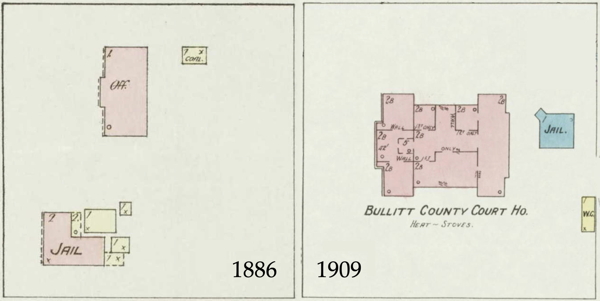
By January 1873 the job was finished. At court, the commissioners reported, "It appearing from an examination this day made that Gild and McGee, contractors, have finished and completed their contract of building the County and Circuit Court clerks' offices, the said offices are now received by us. S. A. McKay, Wilhite Carpenter, Wesley Phelps, Commissioners"
And so a new clerk's office joined the second county jail on the lot that was destined to hold a new courthouse in the future. You can see their locations on the side by side drawings shown here. On the left is shown the jail and clerk's office, both facing Main Street, in 1886. On the right is the same courthouse square showing the new courthouse with the then new stone jail behind it. Of course to make room for the new courthouse, both earlier buildings were removed, found now only in drawings like this.
By the way, if you visit the History Museum and look in the display room where Mrs. Nancy Strange's old Circuit Court Clerk's office once sat, you can still see the door that once enclosed a fireproof vault where so many really old records were stored. Ah! The memories!
Copyright 2026 by Charles Hartley, Shepherdsville KY. All rights are reserved. No part of the content of this page may be included in any format in any place without the written permission of the copyright holder.
The Bullitt County History Museum, a service of the Bullitt County Genealogical Society, is located in the county courthouse at 300 South Buckman Street (Highway 61) in Shepherdsville, Kentucky. The museum, along with its research room, is open 10 a.m. to 4 p.m. Monday through Friday. Saturday appointments are available by calling 502-921-0161 during our regular weekday hours. Admission is free. The museum, as part of the Bullitt County Genealogical Society, is a 501(c)3 tax exempt organization and is classified as a 509(a)2 public charity. Contributions and bequests are deductible under section 2055, 2106, or 2522 of the Internal Revenue Code. Page last modified: 11 Jul 2026 . Page URL: bullittcountyhistory.org/memories/clerkoffice.html
